Most people recognize the unmistakable musty smell of mold. It’s earthy, damp, and unpleasant—but the odor itself isn’t the real concern.
That smell is a warning sign.
When mold produces an odor, it’s telling you something important: There is active mold growth somewhere in your home, even if you can’t see it. And that means there’s moisture, decay, and potential health risks hiding behind the walls, under flooring, or inside HVAC systems.
Here’s why mold odors matter, what they reveal about your home’s condition, and why professional remediation is the safest way to restore your environment.

Most people describe mold odor as “old,” “wet,” or “stale”—but that musty scent is actually a chemical signal your home is trying to send you.
Mold smells musty because it releases MVOCs (Microbial Volatile Organic Compounds) as it grows, feeds, and spreads. These gases are natural byproducts of mold digesting the materials around it—things like:
As mold breaks these materials down, it produces a wide range of compounds; some alcohol-like, some similar to formaldehyde, and some with earthy or mushroom-like tones. Together, they form the unmistakable “mold smell.”
Common ways people describe these odors include:
What’s important to understand is this: Mold odor isn’t passive. It’s the smell of mold actively growing.
Mold doesn’t produce MVOCs when it’s dormant; it only emits these gases when:
This is why a musty odor is a critical warning sign. It means mold is alive and breaking down materials in your home right now. Even if you can’t see visible growth, the smell confirms biological activity happening behind the scenes—often behind walls, under flooring, or inside HVAC systems.
In short: If your home smells musty, mold is working around the clock—even if you can’t see it yet.

Mold doesn’t grow in dry conditions. If you smell mold, moisture is not just possible—it’s guaranteed. That musty odor is often the first clue that water is collecting where it shouldn’t be.
When mold is active, it’s because moisture is feeding it. A musty smell usually points to one or more of the following issues:
Even if everything looks dry on the surface, that odor means the moisture level is high enough to support mold growth behind the scenes.
Water doesn’t stay where it starts. It runs downward, wicks sideways, spreads through porous materials, and can remain trapped long after a spill or leak appears to be cleaned up.
By the time you smell mold, moisture has often already made its way into deeper layers of your home’s structure, including:
Because these areas aren’t visible, the odor becomes the only warning sign that something is happening out of sight.
A musty smell rarely appears right after water exposure. Mold needs time to grow—and that process can start within 24–48 hours of moisture contact.
So when the odor becomes noticeable, it’s often evidence that:
This is why a mold odor should never be ignored. It’s not just telling you something smells bad—it’s telling you your home has an ongoing moisture problem that needs immediate attention.
A mold odor is not a harmless nuisance—it’s a biological indicator. Mold only produces an odor when it is alive, feeding, and expanding. That musty scent is the byproduct of active microbial metabolism, not dormant spores sitting quietly on a surface.
Dormant spores can live for years without producing noticeable smells. They’re inactive, waiting for the right environment to wake up—usually when moisture appears.
So if you catch a musty odor, it’s not coming from dormant spores. It’s coming from mold that is:
A mold odor is essentially the live breath of a growing organism.
When mold is actively growing, a few things are happening simultaneously:
As long as moisture is present, mold will continue to eat, spread, and release odors. Ventilation or deodorizers might temporarily reduce the smell, but the growth itself keeps advancing.
A musty odor means the mold is in a reproductive stage. Colonies expand fast, often doubling in size when moisture levels are ideal.
Growing mold releases spores into the air as part of its natural cycle. These spores travel through:
By the time you smell mold, spore distribution is usually well underway.
Mold feeds on organic components such as:
This breakdown weakens the home’s structure, leading to soft walls, warped flooring, and long-term deterioration.
There is no scenario where mold odor exists without active mold growth behind it. A musty smell doesn’t mean:
It means the issue is happening right now and will continue until both the moisture source and the mold colony are eliminated.

A musty odor doesn’t stay neatly contained to one room. When you smell mold, you’re inhaling the identical microscopic particles that mold releases as it grows spores, fragments, and MVOCs (microbial volatile organic compounds). Even if the colony itself is hidden behind a wall or under flooring, its byproducts circulate through your indoor air.
Over time, this exposure can take a toll on your health.
Many people start to notice symptoms that seem minor or unrelated at first. These can include:
Because these symptoms overlap with those of allergies or the common cold, people often overlook mold as the underlying cause.
Mold-related odors indicate that MVOCs and spores are already airborne. Breathing in these particles can irritate the respiratory system and trigger inflammation, especially for people who are already sensitive to indoor pollutants.
The effects can be more potent if:
Certain groups may develop severe reactions even with short-term exposure, including:
For these groups, mold exposure can lead to significant respiratory distress or recurring infections.
When mold grows behind walls, under floors, or inside HVAC systems, the concentration of spores in the air can increase rapidly. In these situations, people may begin to experience:
Because the odor often appears before visible mold does, the smell is an essential early warning sign that indoor air quality is declining.
Mold doesn’t usually start where you can see it. Long before it appears on walls, ceilings, or flooring, it grows quietly in the dark, hidden spaces of a home. That’s why your nose often detects mold before your eyes ever do.
Mold prefers environments that are:
These are the exact conditions found inside your home’s structural layers. As a result, you may smell mold even though the colony isn’t visible. Some of the most common hidden locations include:
These areas are out of sight but mold growth here still impacts the air you breathe.
Smell is often the earliest warning signal of mold because:
You may not see stain marks, discoloration, or growth until long after the odor appears. By the time mold becomes visible, the problem is usually much larger than it appears on the surface.
This is one of the most common concerns homeowners share when they call Bio-One. They notice:
… but no visible mold anywhere.
That’s because the odor escapes more easily than the mold itself. Think of it like smoke from behind a closed door—you smell it before you ever see flames.
Locating hidden mold requires:
Bio-One of Omaha technicians are trained to find mold growth wherever it's hiding, even in places homeowners would never think to check.

When a musty odor appears, it’s tempting to reach for air fresheners, candles, or DIY odor-eliminating sprays. Some homeowners even invest in ozone machines or deodorizers, hoping to “neutralize” the smell.
But here’s the truth: Anything that only hides the odor is hiding the problem, too.
Mold odor is a symptom of active growth and moisture. If you only mask the smell, the mold continues spreading—quietly, invisibly, and often aggressively.
Temporary solutions such as:
… might make the space smell better, but they do nothing to stop:
In fact, masking the odor often delays action—giving the mold more time to cause damage.
When you cover up mold odor instead of treating the source, you risk:
Mold feeds on drywall, wood, insulation, carpet backing, and adhesives. The longer it grows, the more material it destroys.
Even if you can’t smell the mustiness anymore, spores continue circulating in your indoor air impacting breathing and overall indoor air quality.
Covering up the odor doesn’t stop mold’s biological activity; the irritation to your eyes, sinuses, and lungs continues or intensifies.
If moisture is the issue, and it always is, ongoing water exposure can lead to rot, sagging floors, warping, or soft walls.
What might begin as a small, localized mold colony can grow into an issue requiring demolition, material removal, and full restoration.
Masking odors may create the illusion of a cleaner environment, but the mold is still there quietly releasing spores, damaging your home, and affecting your health. The musty smell isn’t the root of the issue. It’s the warning sign. Ignoring or covering it up allows the real problem to grow unchecked.

A musty odor is your home’s way of saying, “Something is wrong.” But the smell itself isn’t the problem; it’s the symptom. True remediation must address several interconnected issues:
Bio-One of Omaha’s approach is designed to handle all of these layers, not just the odor. Our team combines advanced tools, industry-certified procedures, and years of hands-on experience to eliminate the mold, restore your environment, and prevent the issue from returning.
Here’s what that looks like:
Before any mold can be removed, we must find why it’s growing. Moisture issues often hide behind walls, under flooring, or inside HVAC systems.
We don’t guess. We identify the exact source because unless the moisture problem is resolved, mold will come back.
Once moisture is identified, we locate the mold colony and put immediate containment measures in place.
Containment is crucial. Without it, mold could spread through air currents, vents, and foot traffic into previously clean areas.
Bio-One follows strict professional standards, including EPA, OSHA, and IICRC guidelines. This ensures mold is not only removed, but removed safely.
We do not take shortcuts. Every step protects your health, your home, and your long-term safety.
Mold isn’t just on surfaces, it’s in the air. Using commercial-grade HEPA filters and air scrubbers, Bio-One removes:
This not only clears the musty smell but also improves indoor air quality so you can breathe comfortably again.
Even after structural removal, microscopic spores can settle on nearby surfaces. Bio-One performs detailed cleaning and disinfection to ensure every affected area is treated, including:
This step ensures the colony doesn’t regrow and removes any lingering contamination.
You never have to mask it. You never have to live with it. When the moisture is resolved and the mold is removed correctly, the musty odor goes away on its own because the source no longer exists. Bio-One restores both your environment and your peace of mind.
Mold produces musty odors when it’s actively growing and releasing MVOCs, gases created as it breaks down materials like wood, drywall, and insulation. If you smell mold, it means growth is happening right now.
Yes. Most mold begins in hidden areas such as wall cavities, under flooring, behind cabinets, or inside HVAC systems. Odor often appears weeks or months before mold becomes visible.
A mold odor confirms that moisture is present whether from a leak, high humidity, condensation, or poor ventilation. Mold cannot grow without moisture, so the smell is a guaranteed warning sign.
Yes. Musty smells indicate that spores and MVOCs are already airborne. Breathing them in can cause headaches, coughing, sinus issues, fatigue, and worsen asthma or allergies.
Children, older adults, pregnant individuals, people with allergies or asthma, and anyone with a weakened immune system may experience stronger reactions or more severe symptoms from mold exposure.
Odor molecules travel through the air much faster than mold can break through surfaces. By the time you see mold, the colony is usually well established behind walls or flooring.
No. Masking the odor doesn’t address moisture or remove mold. It can delay proper treatment and allow the colony to grow, leading to more damage and higher remediation costs.
Bio-One uses moisture meters, thermal imaging, air sampling, and detailed inspection techniques to find hidden mold growth—even in places homeowners rarely think to check.
Bio-One identifies the moisture source, contains the affected area, safely removes mold and contaminated materials, filters the air, disinfects surfaces, and provides guidance to prevent future growth.
Yes. When the moisture problem is fixed and the mold colony is fully removed, the odor disappears naturally because the source no longer exists—no masking necessary.

We are delighted to announce our sponsorship of the First Responder Relay in Las Vegas on October 16th. The First Responders Relay is a 9 person 48-mile running relay with stages ranging from 4.0 miles to 7.7 miles. The relay is competition comprised of first responder personnel from throughout the United States and the World, and is hosted by the California Police Athletic Federation (CPAF).
There is still time to register, but don't delay! Registration closes September 18. Visit www.CPAF.org to join us in Las Vegas!
The California Police Athletic Federation (CPAF) is proud to announce that the 2021 United States Police & Fire Championships (USPFC) are now Presented by Bio-One, Inc.
Operating under the motto, "Help First, Business Second," Bio-One provides high-level decontamination and biohazard cleanup services while offering clients the privacy and compassion needed at difficult times. Bio-One operates in 41 states with over 110 locations and is committed to providing first-class service.
"We are thrilled to add Bio-One as the Presenting Sponsor for the 2021 USPFC because First Responders warrant our support," said California Police Athletic Federation President LC Collins. "Bio-One’s reputation is second to none, and with their partnership, we can offer first responders a health and wellness outlet. We look forward to working with them for years to come."
Founded by San Diego Police Lieutenant Veon "Duke" Nyhus, The United States Police & Fire Championships were first held in San Diego in 1967. Duke recognized the need to promote physical fitness and camaraderie among the Public Safety and First Responder community members.
The USPFC caters to active and retired public safety and first responders who participate in Olympic-style competitions and open to individuals representing firefighters, law enforcement, and officers from corrections, probation, border protection, immigration, and customs across the country. Traditionally athletes compete in 45+ sporting events from biathlon to motocross across 35+ venues in Southern California.
"At Bio-One our support for Law Enforcement and Fire Service Officers is unwavering, and we're thrilled to partner with the California Police Athletic Federation during this memorable event," said Nick-Anthony Zamucen, founder of Bio-One. "We wish each athlete success and look forward to celebrating these everyday heroes."
The 2021 USPFC Presented by Bio-One will take place from June 10th to the 19th in venues across San Diego, California, and strengthen the relationship between First Responders and the community for many years to come!
About the United States Police and Fire Championships
The California Police Athletic Federation (CPAF) is the parent organization of two multi-sport programs designed for peace officers and firefighters. The World Police & Fire Games (WPFG) are open to active and retired law enforcement and fire service personnel throughout the world. The United States Police & Fire Championships (USPFC) are open to active or retired public safety and first responder personnel from an eligible agency within the USA. For more information, please visit www.uspfc.org.
Bio-One ranked number one in Entrepreneur magazine’s 42nd Annual Franchise 500 for success in crime-scene and trauma-scene cleaning. This marks the fifth year in a row that Bio-One has been included in the ranking.
Omaha, Nebraska – Bio-One ranked number one in Entrepreneur magazine’s 42nd Annual Franchise 500 for success in crime-scene and trauma-scene cleaning. This marks the fifth year in a row that Bio-One has been included in the ranking.
Bio-One is locally owned and operated by Derek and Daniela Myers. Since 2019 they have served community members, businesses, and government agencies throughout eastern Nebraska.
Bio-One provides service in recovery and suicide cleanup, homicide cleanup, hoarding situations, junk removal, deceased animal recovery, feces removal, pest and rodent droppings and more.
“We decided to join Bio-One because of the difference we wanted to make in our community,” said Daniela Myers, owner of Bio-One. “We have loved being able to live out our motto of ‘Help First, Business Second’.”
The number of Bio-One franchises have increased 145 percent in the last three years with over 100 locations in 41 states.
“We’re honored to be recognized by Entrepreneur,” said Nick-Anthony Zamucen, CEO of Bio-One Inc. “The ranking is a direct reflection of our Bio-One family, strength of our business model, and our ability to consistently deliver care and compassion to our clients.”
Over its 42 years in existence, the Franchise 500® has become both a dominant competitive measure for franchisors and a primary research tool for potential franchisees. Bio-One’s position on the ranking is a testament to its strength as a franchise opportunity.
About Bio-One Inc.
Bio-One Inc. is the first crime and trauma scene cleaning franchise, operating in 41 states with over 100 locations. Bio-One is committed to providing excellent service in recovery and suicide cleanup, homicide cleanup, hoarding situations, junk removal, deceased animal recovery, feces removal, pest and rodent droppings and much more. Each office is independently owned and operated by a member of the local community. For more information about Bio-One, visit us at biooneomaha.com.


With SARS-CoV-2 (COVID-19) cases rising in Nebraska, businesses and individuals are being urged to follow social distancing guidelines. The state now has over 100,000 cases and the virus is spreading faster than it was this spring. The Nebraska Department of Health and Human Services has issued Directed Health Measures that are in effect from November 16 - November 30, 2020. These measures restrict gatherings and remind businesses to follow all COVID-19 safety precautions.
The latest case numbers can be overwhelming, but below are some simple steps to help slow the spread of the virus.

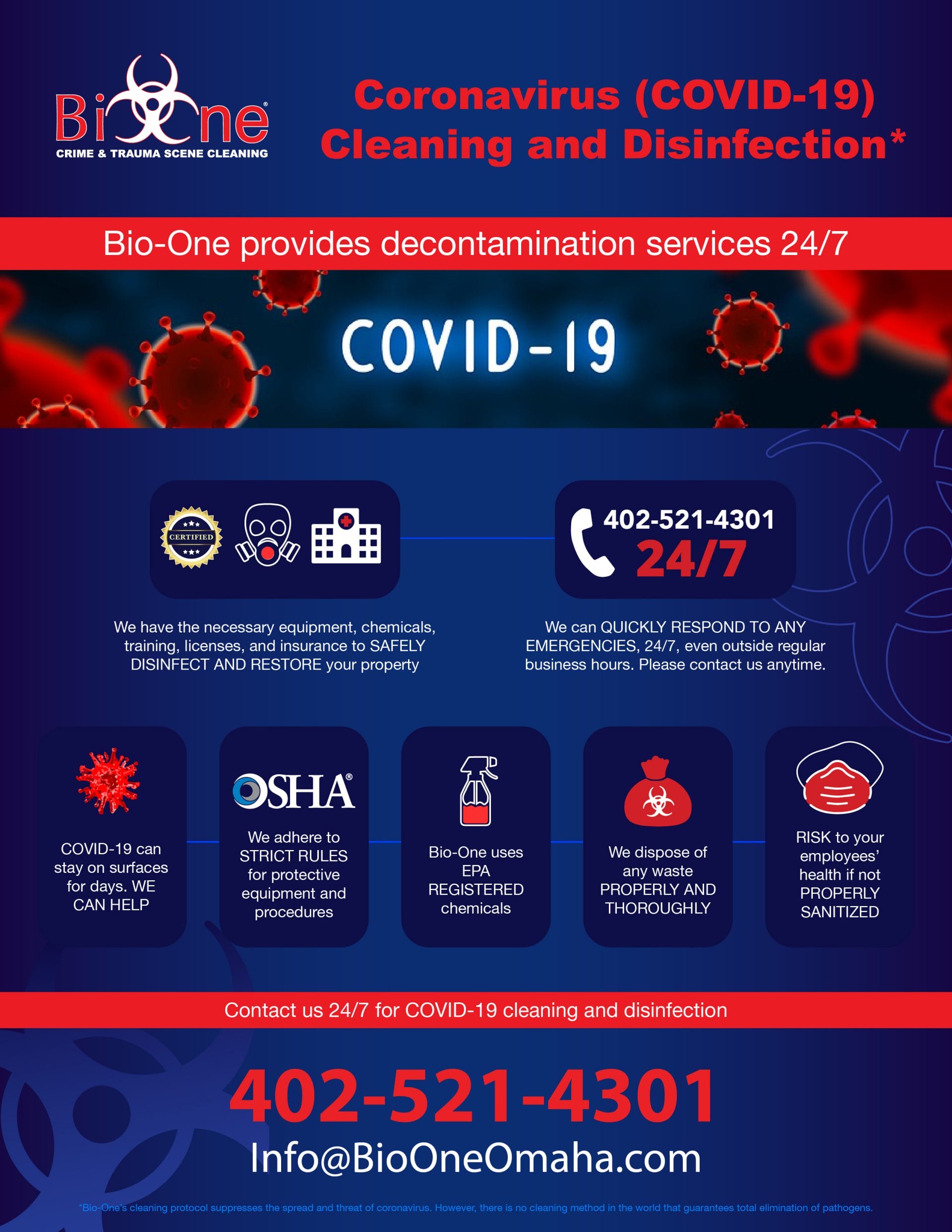
What can you do? According to the CDC and the NE DHHS below are a few steps to help slow the spread:
If you have a co-worker or employee who has tested positive for SARS-CoV-2 and you would like a professional disinfection done, Bio-One can help.
What to look for in a cleaning company?
When choosing a company make sure you are hiring a professional you can trust.
Bio-One has experience in disinfecting SARS-CoV-2 and other infectious disease. All disinfections are done using chemicals from the EPA List N.
No matter what the situation, the professionals at Bio-One are here for you to answer your questions or concerns. Hire someone you can trust.
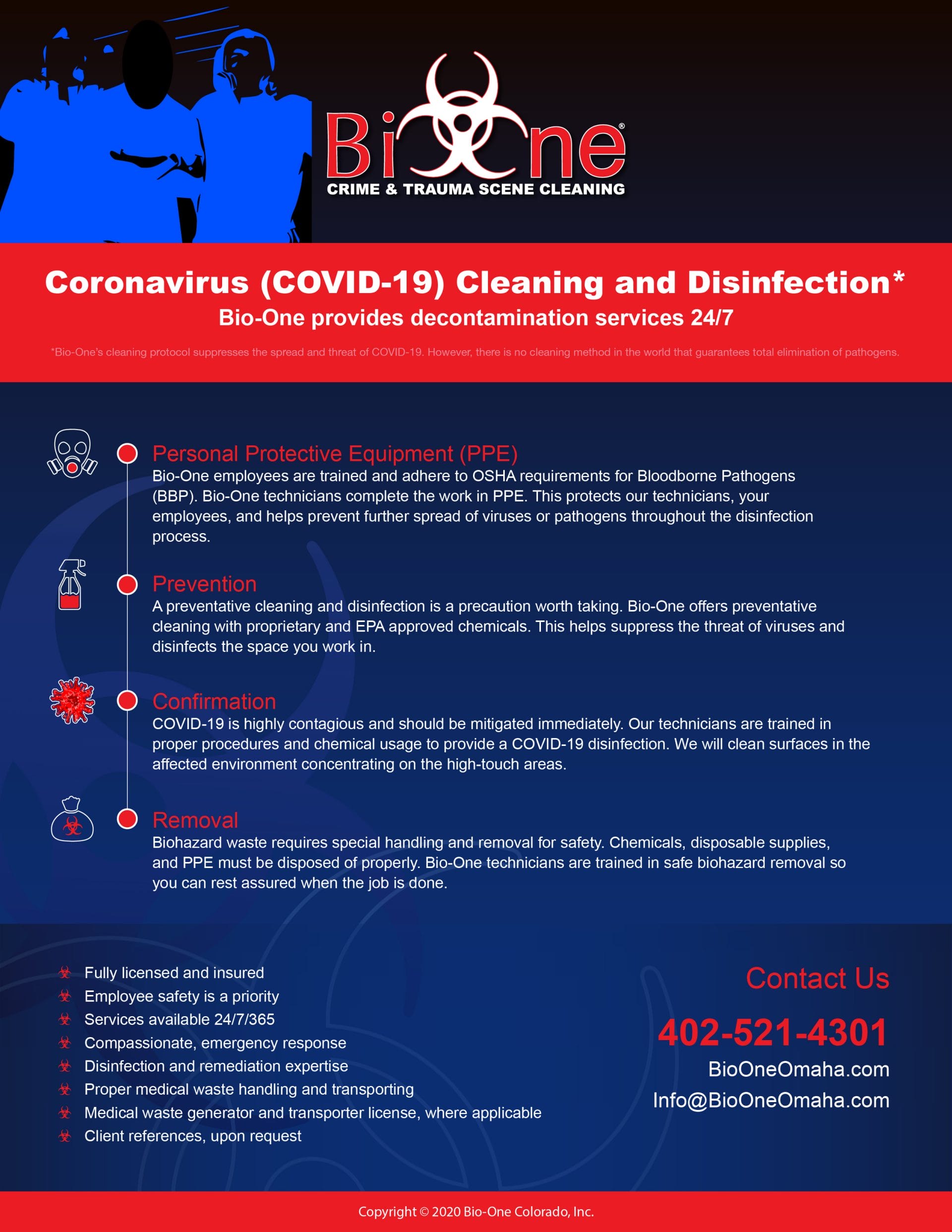
How To Reopen A Business After COVID-19
Bio-One Can Help
As restrictions across the country start to lift, business owners are faced with new challenges on how to make workplaces safe for employees and customers. SARS-CoV-2, the virus that causes COVID-19, has changed the way we think about safety.
The Center for Disease Control (CDC) has classified SARS-CoV-2 as a "Biohazard Level 3".
Biohazard Level 3 includes microorganisms that can be fatal to humans but for which vaccines or other treatments are available.
Most of us are familiar with the recommended safety behaviors to begin reopening public spaces and workplaces:
In addition to these safety behaviors, the CDC has released guidance for reopening businesses. Per the guidance, it is important for business owners and employers to develop a plan to clean and disinfect their workplaces. Disinfection should be done with a product from the EPA's List N: Disinfectants for Use Against SARS-CoV-2. It is also important to consider the proper Personal Protective Equipment (PPE) that should be worn by anyone who is using these chemicals. This guide is a helpful resource but is lengthy and can feel very complex.
Per the Occupational Safety and Health Administration (OSHA), employers should monitor public health recommendations regarding COVID-19 and they should communicate these recommendations to employees. Employers who oversee staff that is cleaning and disinfecting need to consider the increased risks to employees due to exposure to COVID-19 and to toxic cleaning chemicals.
If all of this information seems overwhelming, don't panic. Consider calling a biohazard cleaning professional like Bio-One to answer questions. Bio-One has franchises across the country to help businesses of any size.
At Bio-One of Omaha we will give a free COVID-19 consultation to help you decide if your business needs a professional cleaning. Please give us a call at 402-521-4301 if you have any questions.
Bio-One Services


Mental Health Awareness Month
During the month of May, you will start to see green ribbons throughout social media or even out in town. These green ribbons are to help bring awareness to Mental Health during the month of May. Unfortunately, many people are affected by a mental illness and you may not even know it. National Alliance on Mental Illness breaks down some facts and numbers for us.
Prevalence of Mental Illness in the U.S.
Consequences of Lack of Treatment
Impacts of COVID-19 on Mental Health
2020 has brought new challenges to those experiencing mental illness. The social distancing requirements due to COVID-19 have caused an increase in calls to suicide hotlines. The anxiety and stress of financial impacts and the fear of losing loved ones are taking their toll across the U.S. While social distancing can help keep the illness from spreading, people are more isolated as they try to cope with fears, stress, and substance abuse. The demand for mental health counseling services is also on the rise.
Suicide hotlines are urging to people to reach out and call to check in with loved ones if you cannot see them in person.
If you, or someone you know needs help or just needs to talk please call the NAMI helpline listed below.
1-800-950-6264
Or, in a crisis? Text NAMI to 741741


We at Bio-One are here to help with your needs during what can be difficult times. If you need more immediate assistance, please call 402-521-4301. No job is too big, no mess is too small, we are here to serve you.
When you or someone you know finds out a friend, relative, co-worker, or employee might be infected with COVID-19 it can cause a sense a panic. Bio-One Omaha has the proper training to decontaminate a scene with infectious disease present, we have the proper EPA approved chemicals, and have the proper Personal Protective Equipment (PPE). There are several companies who advertise they can perform disinfection services for your home or business. Before you chose who to hire, here are some questions you should ask:

1. What chemicals are being used for disinfection?
All chemicals used by Bio-One are EPA List-N approved for fighting the SARS-CoV-2 pandemic. We make sure all disinfectants are applied per product specifications.
2. Is proper PPE being utilized during the disinfection of your home or business?
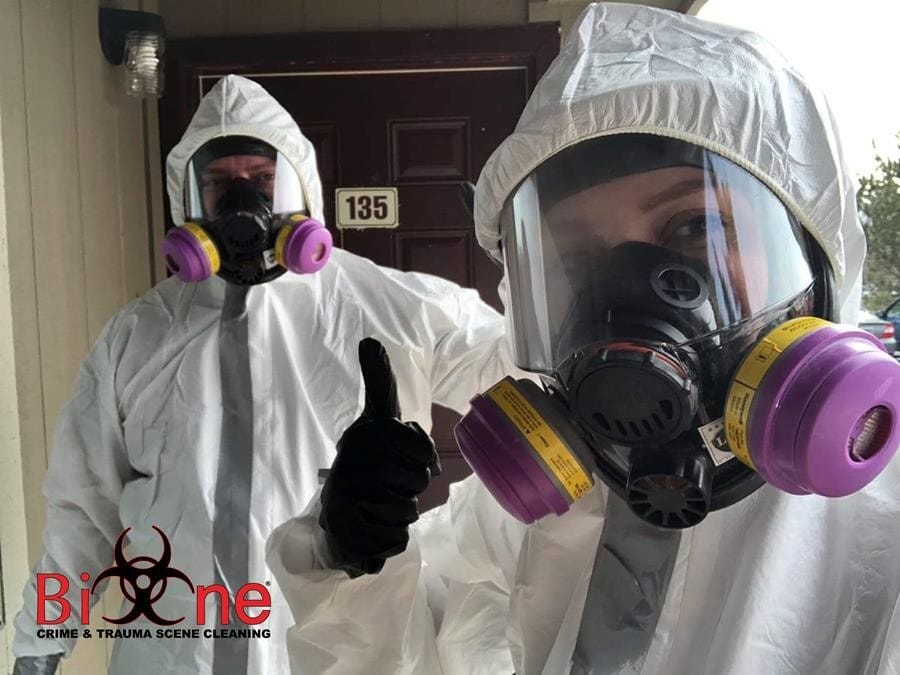
All of our technicians wear bio-suits, double gloves, double booties, eye protection, and respirators with P100 cartridges. This ensures the safety of our technicians and also minimizes the possibility of cross contamination.
3. Are the technicians trained in CDC and OSHA Protocols?
We at Bio-One are fully trained on these protocols and follow them in their entirety.
4. Is the company you hire properly insured?
At Bio-One we are fully insured including pollution liability, specialty coverages for performing biohazard remediation. Ask to see the Certificate of Insurance (COI) for any company you are thinking of hiring.
If the company you are hiring cannot answer the questions above, they are not qualified to be considered to do the disinfection.
If you, someone who lives with you, or someone you came into contact with tested positive for coronavirus, call a professional for help. Bio-One services all types of trauma and regularly disinfects for bloodborne pathogens, viruses, and bacteria such as HIV, Hepatitis, MRSA, C-Diff, and many others.
We perform confirmed and proactive cleanings and are available around the clock to ease your mind and help you and your family feel safe. Don't hesitate to call or e-mail us. We are here for you.


Are you concerned about buying a home without it being properly disinfected? Does your home need to be deep cleaned and disinfectd before you put it on the market? Are pet or tobacco odors making it hard to sell your home?
Bio-One is here to help! We use EPA registered chemicals and follow all CDC procedures to make sure your new home is disinfected before you move in. We have experience disinfecting after infectious diseases; including MRSA, COVID-19, and others.
We offer deep cleaning and disinfecting to make sure your house is ready to sell. We can treat for animal waste and pet odors and treat for tobacco odors.
We even offer junk removal and hoarding services.
Give us a call! 402-521-4301

COMMUNITY RESOURCES FOR ECONOMIC ASSISTANCE
At Bio-One Omaha our mission is to help first in our community. We have put together the following list of community resources for anyone who might need economic assistance during the SARS-CoV-2 pandemic. We know this is not a comprehensive list, so please reach out to any local charities, community centers, and churches if you are in need. We are always stronger together and the best way to help our country is to reach out and help a neighbor in need.
402-682-6602
Eastern Nebraska Community Action Partnership (ENCAP)
402-453-5656
Douglas County General Assistance Center
402-444-6215
Sarpy County General Assistance
402-593-4400
Family Housing Advisory Services
402-934-7921
402-345-8047
402-553-3000
402-422-1111
Eastern Nebraska Office on Aging (ENOA)
402-444-6536
Disconnections are suspended until April 30, 2020
Services will not be disconnected for non-payment